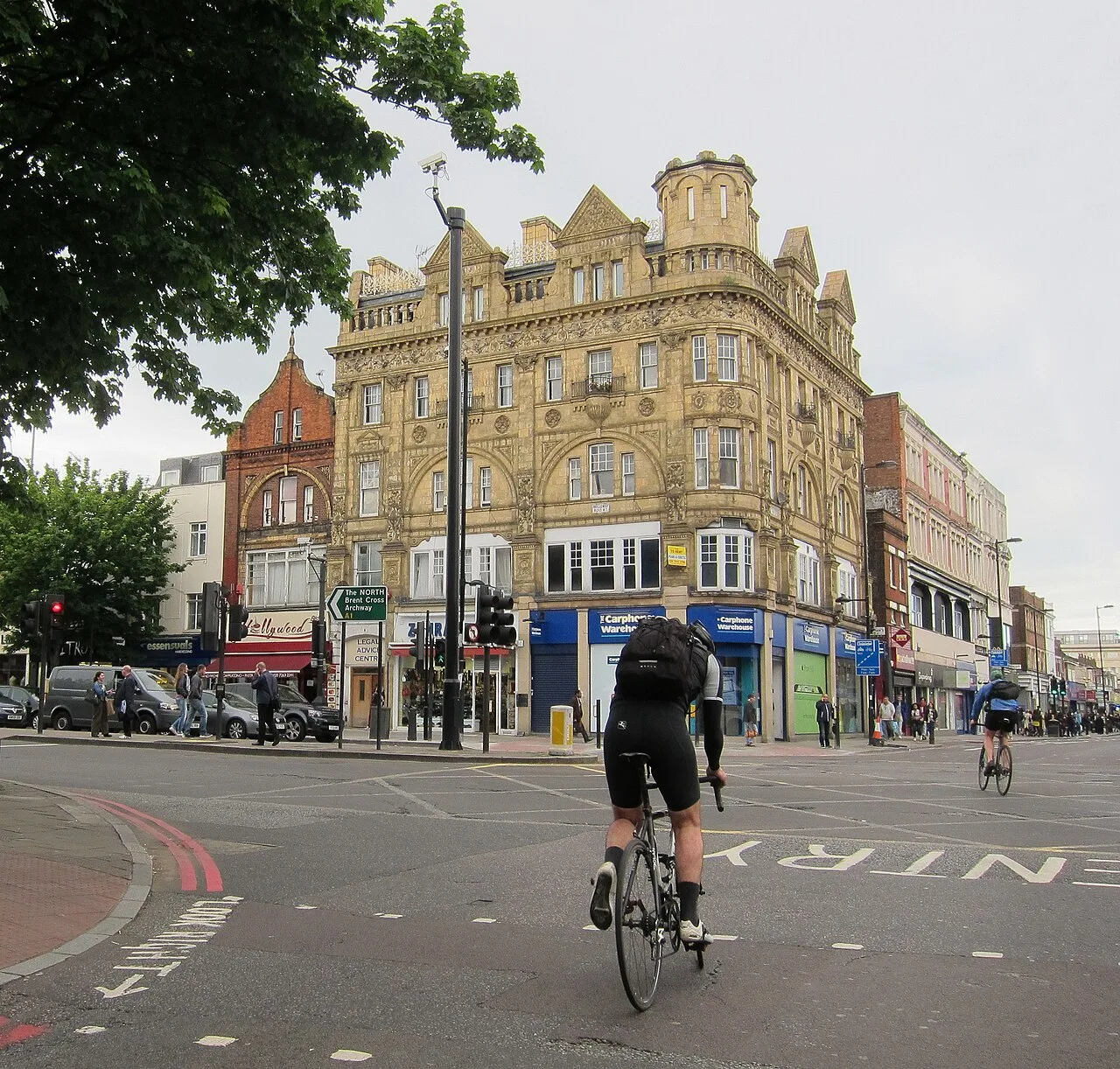

Islington has refused a 24-hour adult gaming centre in the old bank at 403 Holloway Road. Officers counted seven gambling premises within 200m.
Islington Council has refused planning permission for a 24-hour adult gaming centre in the empty bank at 403 Holloway Road, on the corner of Parkhurst Road in Nag’s Head.
The decision notice was issued on Tuesday 22 September. It gives three reasons for refusal. Council officers found seven gambling premises within 200 metres of the site, including two slots venues that already open 24 hours a day (decision notice, P2026/1808/FUL).
The applicant, Cain’s Amusements, can appeal. A separate gambling licence application for the same premises is still a live question, and planning law does not decide it.
What was proposed
The application sought a change of use of the ground floor of No. 403 from a bank to an adult gaming centre, a slot machine arcade for over-18s. No. 405, the other half of the unit, would have been walled off and stayed as a shop unit. The flats on the upper floors are unaffected.
The council’s report says the bank closed in August 2022 and the unit has been empty since. The building is locally listed (Grade B) and sits inside the Nag’s Head Primary Shopping Area (delegated report).
The application was made on 8 July through the agents Bidwells. It was decided by officers under delegated powers, not by a planning committee.
Why the council said no
The decision notice gives three reasons. In short:
- Losing a shop unit. The council’s policy says a ground-floor shop unit in a Primary Shopping Area can only change to another use after 12 months of continuous marketing. The applicant sent one letter from the letting agents JLL. Officers said that was not enough to show no other shop or service could use the unit.
- Too many gambling premises already. The council’s policy R8 bars a new betting shop or adult gaming centre in a town centre if another one is within 200 metres’ walk. Officers found seven.
- Health. The applicant’s rapid health impact assessment said the arcade would have a neutral to positive effect on health. Officers said a full assessment was needed and had not been done.
The report is blunt about the town centre. It calls Nag’s Head “saturated” with gambling uses. It says the neighbourhood is more deprived than 84% of areas in England overall, and more deprived than 71% on crime. It also puts the site in one of the council’s Gambling Vulnerability Zones, from the gambling licensing policy for 2026 to 2028.
The seven within 200 metres
Officers listed eight gambling premises within 500 metres, measured by walking distance on Google Maps. The report notes that the applicant’s own risk assessment had put several of them further away than they are.
| Premises | Address | Type | Distance |
|---|---|---|---|
| MERKUR Slots | 456 Holloway Road | 24-hour adult gaming centre | about 40m |
| Admiral Casino | 3 Seven Sisters Road | 24-hour adult gaming centre | about 55m |
| Betfred | 10-12 Seven Sisters Road | Betting shop | about 60m |
| Coral | 369 Holloway Road | Betting shop | about 145m |
| Ladbrokes | 502 Holloway Road | Betting shop | about 160m |
| William Hill | 37 Seven Sisters Road | Betting shop | about 190m |
| Paddy Power | 42-44 Seven Sisters Road | Betting shop | about 190m |
| Ladbrokes | 330 Holloway Road | Betting shop | about 480m |
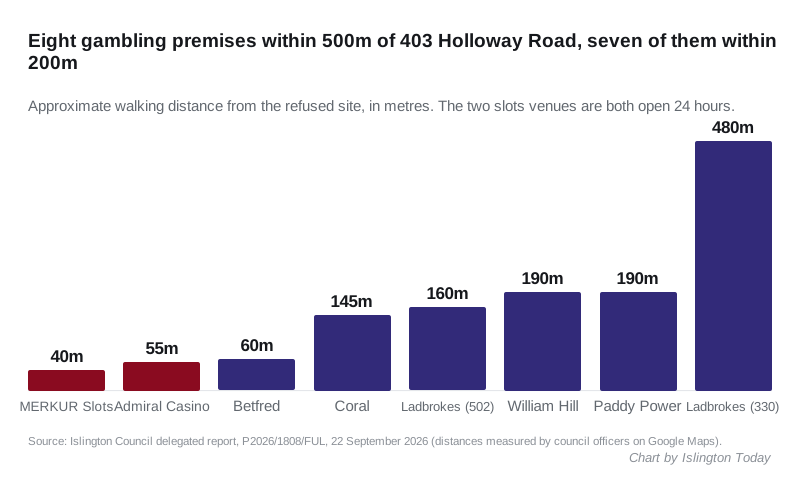
MERKUR Slots at No. 456 is in the old Nag’s Head pub itself. The officers’ report calls that unit “symbolic of the challenges faced in Nag’s Head with a concentration of pawnbrokers, betting shops and money lenders”.
Who objected, and who did not
The council wrote to 206 nearby addresses on 7 August and put up a site notice. By the time the report was written it had 80 objections from the public. Objections also came from:
- the Tufnell Park ward councillors
- the Holloway Neighbourhood Group
- the Al-Risaalah Mosque and Islamic Centre next door
Four council teams objected too: planning policy, public health, community safety and licensing.
The Metropolitan Police’s Design Out Crime Officer did not object. The report records the officer’s view that the arcade “may be detrimental but nothing tangible to object to at this time”.
What happens next
An appeal is possible. The applicant has six months from the date of the decision to appeal to the Planning Inspectorate, which runs to 22 March 2027. The applicant’s supporting papers already cite three earlier planning appeals from elsewhere in London, in Lewisham, Eltham and Ilford.
The licence is a separate process. Under section 210 of the Gambling Act 2005, a licensing authority must not take into account whether a proposal is likely to get planning permission. So the planning refusal does not, by itself, end a gambling premises licence application. It does mean the arcade could not lawfully open in the unit without winning a planning appeal.
The council’s committee calendar lists a Licensing Sub-Committee A meeting on Tuesday 6 October. Its agenda had not been published when we checked on 27 September, so we cannot yet confirm this application is on it.
What it means for you
- If you objected, you do not need to do anything now. If an appeal is lodged, the council normally writes to people who commented, and you can send your views to the Planning Inspectorate.
- If you want to follow the licence, watch the Licensing Sub-Committee agendas on the council’s democracy pages. People who made representations on a gambling premises licence can attend the hearing.
- The unit stays empty for now. The report says the bank has been marketed since August 2022. The council’s view is that another shop or service use is still possible there.
For other decisions around the borough, see our Islington planning news page.
Sources
- Islington Council planning register, P2026/1808/FUL: the decision notice of 22 September 2026 and the officers’ delegated report, for the reasons, the distances, the consultation and the consultee responses.
- Gambling Act 2005, section 210, on licensing and planning being separate.
- Islington Council: licensed gambling in Islington, for the gambling policy 2026 to 2028.
Have your say