
Council tenants would need permission to charge an e-bike at home and fit carpet, not laminate, under rules going to Executive on 17 September. The full list.
Islington’s council tenants would need the council’s permission to store or charge an e-bike or e-scooter in their own home, under new tenancy rules. The rules would also ban holiday lets and require fitted carpet in most rooms.
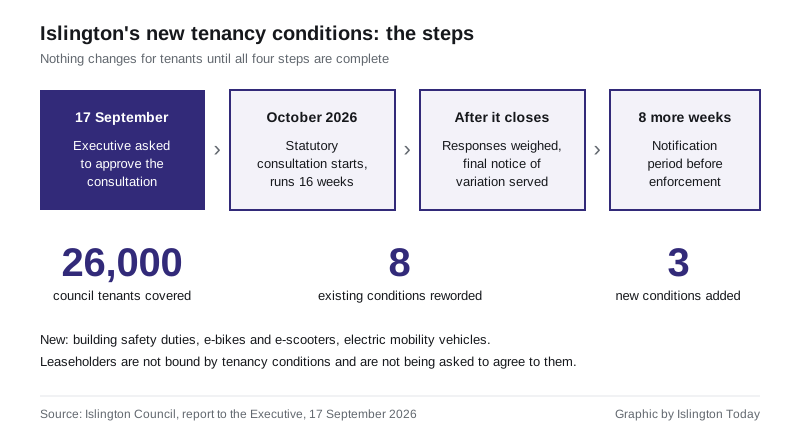
The council’s Executive will be asked on Thursday 17 September to approve a public consultation on the changes. The report to the meeting says they would apply to all 26,000 council tenants.
Nothing changes yet. If the Executive agrees, the consultation starts in October and runs for 16 weeks. After that, tenants get a further eight weeks’ notice before any new condition is enforced.
E-bikes, e-scooters and mobility scooters
These are the biggest changes, and they are new conditions rather than rewordings. The report says lithium-ion batteries “can create serious fire and building safety risks (as previously experienced)” when damaged, stored or charged badly.
Under the proposed wording, tenants:
- must not store or charge an e-bike, an e-scooter or their batteries in communal areas, hallways, garages or anywhere on an estate
- would need the council’s permission to store or charge one inside their home
- must always be in the property while any lithium battery is charging
The report says permission for communal areas “will not be granted … under any circumstances”.
Electric mobility vehicles get a separate rule. Tenants could keep one at home, but only with written permission backed by a medical professional’s report. A mobility scooter could only be kept outside the home in a designated storage area, again with written permission. The council says it “will not unreasonably withhold permission”. It also says it will look at more mobility scooter storage where there is evidence of demand, “subject to feasibility and affordability”.
The other changes
Eight existing conditions would be reworded. The ones most tenants will notice:
| Condition | What would change |
|---|---|
| Flooring | Floors other than kitchens and bathrooms must have fitted carpet, not laminate or wood, with underlay to cut noise |
| Alterations | Written permission needed first for a satellite dish, outside decoration, laminate, wooden or tiled floors, security grilles or gates, or an outside key safe |
| Business use | No holiday lets, boarding houses or other commercial use without written permission. The report names long-term Airbnb lets |
| Rubbish | Recycling must go in the recycling containers, and Estate Services must be told about large items |
| Pets | Tenants responsible for animals damaging the home, and a named ban on dogs prohibited under the Dangerous Dogs Act 1991 |
| Access | 24 hours’ notice for access except in emergencies. If the council has to get a court order, it may seek its costs where the law allows |
If a tenant makes an alteration without permission, the council could ask for it to be removed or do the work itself and recharge the tenant. It could also take action for breach of tenancy.
Two changes are administrative. Letterboxes would become the council’s responsibility to maintain, not the tenant’s. The succession rules would be reworded to match the Localism Act 2011, which the report says limits succession on tenancies granted since 1 April 2012 to a spouse or partner.
A further new condition reflects the Building Safety Act 2022. Tenants must not create a significant fire or structural risk, must not interfere with safety equipment in communal parts, and must give the building’s accountable person information needed to manage safety.
If you already have laminate
The report says existing alterations, flooring included, “will not automatically be treated as a breach” just because they predate the new rules. It promises no blanket inspections. Problems would normally come to light through noise complaints, repair visits or tenancy checks. Officers would discuss the case with the tenant and consider retrospective permission before any formal action.
What it means for you
If you are an Islington council tenant, the consultation is the point at which your view counts. The report says notices will go out by post. It also promises online surveys, drop-in events and one-to-one meetings. Material will be available in community languages and Braille. The consultation also covers homes run by tenant management organisations.
If you keep an e-bike or e-scooter on a landing, in a hallway or elsewhere on the estate, that would no longer be allowed, and keeping one indoors would need permission.
If you are a leaseholder, tenancy conditions do not bind you and you are not being asked to agree to them. The report accepts that some changes could affect you indirectly, in communal areas, fire safety and rubbish.
The Executive meets at 5pm on 17 September. The agenda has the full report, the survey questions and the equality impact assessment. For collection days and what goes in which bin, see our Islington bin collection days guide.
Sources
- Consultation on proposed new tenancy conditions, report 1032985 to the Executive, Islington Council, 17 September 2026
- Agenda for Executive, 17 September 2026, Islington Council
Have your say